In this blog, we will discuss Why Shopify Chose Native Over React Native.
Introduction
In 2020, Shopify used React Native for iOS and Android. Technology evolved, leading Shopify back to native Swift and Kotlin.
In this article, we explore the official engineering reasons behind Shopify’s shift back to native mobile apps.
To build high-performance native apps for your business, try the Mobikul Mobile App Builder.

1. Why Switch Back to Native
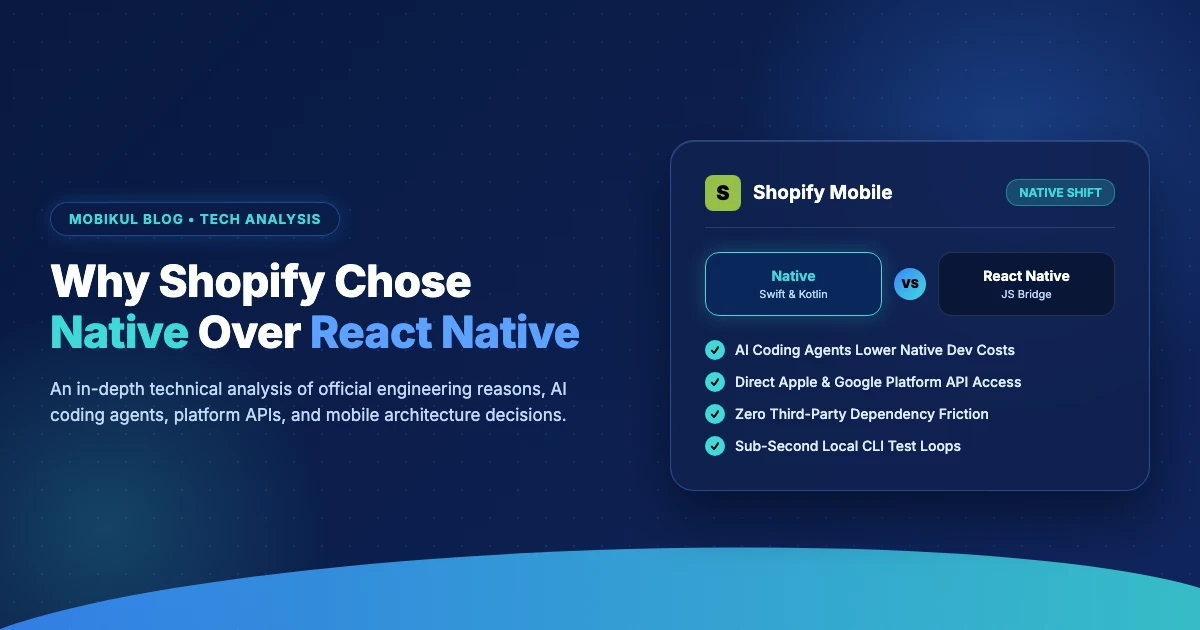
Cross-platform frameworks previously saved duplicate work across platforms. AI coding agents now implement and test native Swift and Kotlin rapidly.
This productivity boost removes the cost penalty of dual native codebases. Maintaining Swift and Kotlin apps no longer requires double the effort.
Native development connects engineers directly to Apple and Google capabilities. Developers access new OS features immediately without waiting for third-party wrappers.
Shopify now builds widgets, Siri shortcuts, and watch apps seamlessly. Direct platform access delivers higher stability and full feature support.
Cross-platform apps spend continuous resources maintaining JavaScript bridges and external packages. Third-party dependency updates frequently introduce breaking app changes.
Returning to native Swift and Kotlin eliminates extra abstraction layers. Read the official post at Shopify Engineering Back to Native.
2. The Future of React Native Open-Source Libraries
Shopify remains committed to supporting open-source libraries like React Native Skia and FlashList for the developer community.
Smaller utility packages like Restyle will be archived at the end of 2026, focusing engineering resources on native Swift and Kotlin.
3. How Shopify Is Migrating to Native Apps
Evaluating brownfield versus greenfield migrations, Shopify chose greenfield rebuilds to eliminate legacy cross-platform tech constraints.
Assisted by AI, Shopify rebuilt the Shop app natively in Swift and Kotlin in just 12 weeks, publishing to app stores quickly.
Migration of the 300-screen Shopify merchant app is currently underway, with Point of Sale and Inbox following soon.
4. Fast Feedback Loops and Preventing Slop
Shopify built an internal tool named Helix to break native rebuilds into testable checkpoints verified by automated tests.
Decoupling business logic to run headlessly via CLI enables AI agents to test native code in milliseconds instead of slow simulators.
5. What’s Next for Mobile Engineering at Shopify
Shopify is transitioning all mobile apps to Swift and Kotlin, exceeding previous benchmarks for app speed and accessibility.
This architecture enables human engineers and AI agents to build together, shipping better commerce experiences faster for merchants.
Conclusion
Shopify’s return to Swift and Kotlin highlights how AI tooling simplifies high-performance native mobile application development.
For custom mobile app development or technical support, contact our team at Mobikul Contact or email support@webkul.com.